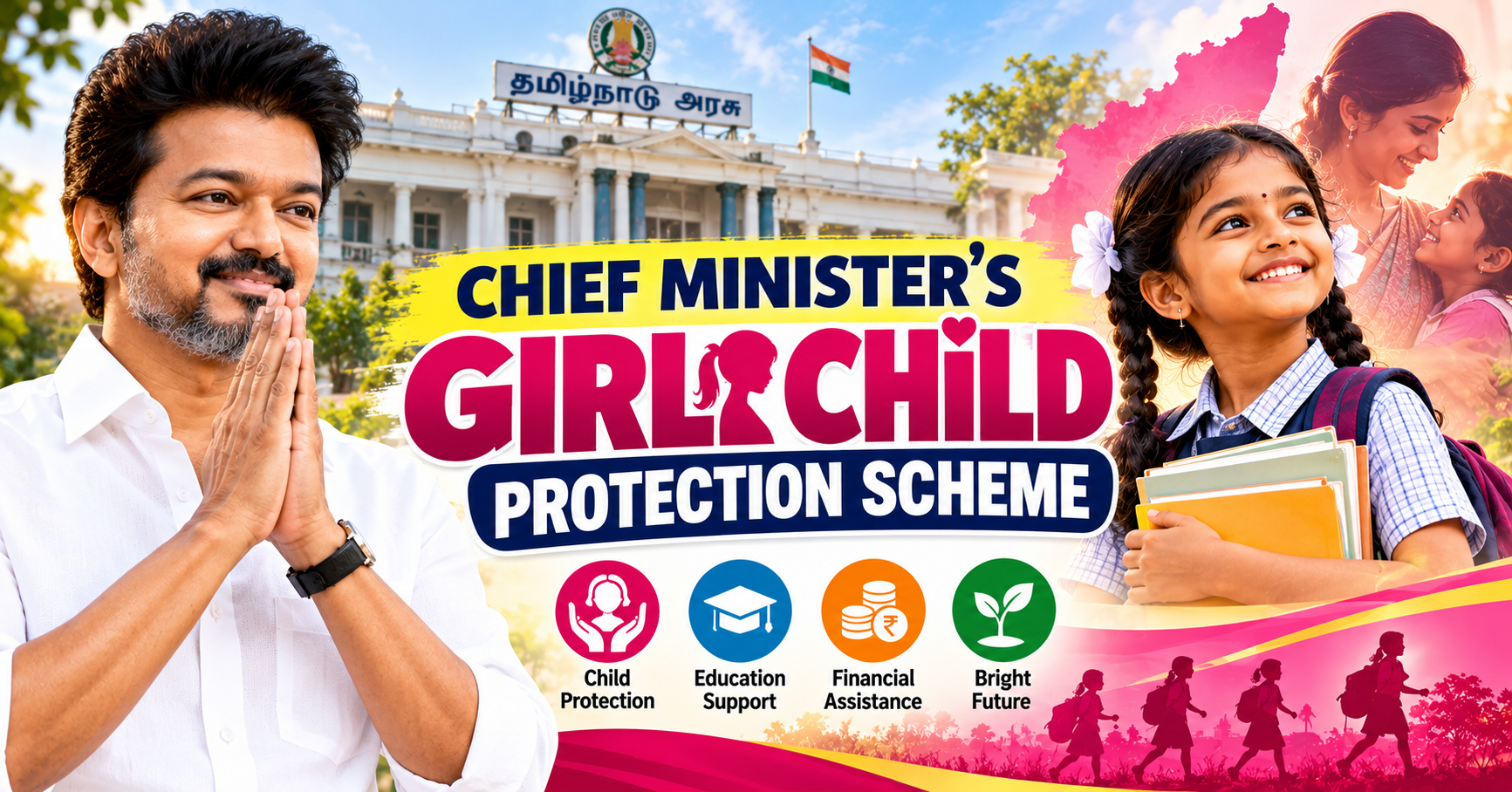
Introduction to the Chief Minister’s Girl Child Protection Scheme
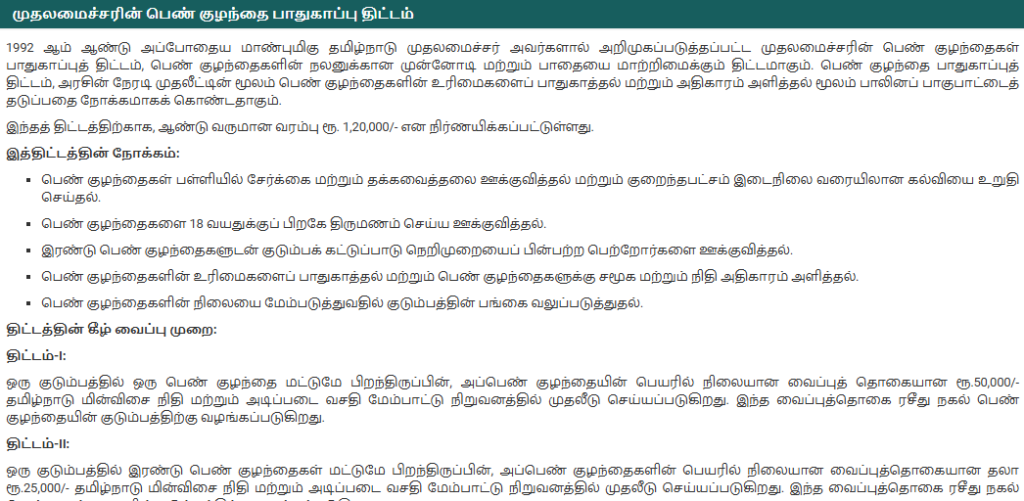
The Chief Minister’s Girl Child Protection Scheme is an important welfare initiative introduced by the Government of Tamil Nadu in 1992 to improve the social and economic status of girl children. The scheme was designed to protect the rights of girls, reduce gender discrimination, encourage education, and provide financial security to daughters from eligible families. It also aims to discourage female infanticide and promote the importance of raising girl children with equal opportunities.
Through this scheme, the Tamil Nadu Government provides financial assistance in the form of a long-term deposit in the name of an eligible girl child. This financial support is intended to help her pursue education and build a more secure future as she approaches adulthood. The scheme also encourages parents to adopt family planning practices and support their daughters’ education instead of preferring male children. For families who meet the eligibility conditions, it can provide valuable financial support during an important stage of a girl’s life.
Objectives of the Girl Child Protection Scheme
The main objective of the scheme is to create a society where girl children receive equal respect, protection, and opportunities. In many economically disadvantaged families, financial difficulties can affect a girl’s education and future plans. This government initiative seeks to reduce some of these challenges by providing a financial deposit that becomes available when the girl reaches the specified maturity age, subject to the scheme’s conditions.
Related Posts
Another important objective is to discourage gender-based discrimination and promote the value of every girl child. The scheme encourages parents to continue their daughters’ education and delay marriage until they reach the legally permitted age. It also supports the small-family norm by providing assistance through two different categories based on the number of girl children in the family. Overall, the programme connects financial assistance with the broader goals of education, gender equality, and child welfare.
Types of the Chief Minister’s Girl Child Protection Scheme
The scheme has two main categories, commonly known as Scheme-I and Scheme-II. These categories are designed for eligible families with either one girl child or two girl children. The financial assistance is deposited in the name of the beneficiary rather than being provided as an unrestricted immediate cash payment to the parents.
Under Scheme-I, a fixed deposit of ₹50,000 is made in the name of the eligible girl child in a family with only one girl child. Under Scheme-II, a fixed deposit of ₹25,000 is made in the name of each of the two eligible girl children in a family with two girl children only. The deposits are managed through the Tamil Nadu Power Finance and Infrastructure Development Corporation Limited, according to the scheme provisions. Families should verify the applicable rules for their child’s birth date and application category before submitting a request.
Scheme-I: Financial Assistance for One Girl Child
Scheme-I is intended for eligible families with only one girl child. Under this category, the government deposits ₹50,000 in the girl’s name as a fixed deposit. Official Tamil Nadu scheme information specifies that this deposit category applies to eligible girl children born on or after 1 August 2011, subject to the scheme’s eligibility requirements. A copy of the fixed deposit receipt is provided to the family as proof of the investment.
The main benefit of Scheme-I is long-term financial security. Instead of giving the entire amount directly to the family immediately after the child’s birth, the scheme preserves the investment for the beneficiary’s future. When the girl reaches the prescribed maturity age, she may claim the matured amount with applicable interest, subject to the scheme conditions. This financial support can help with higher education, vocational training, or other important expenses associated with entering adulthood.
Scheme-II: Financial Assistance for Two Girl Children
Scheme-II is designed for eligible families with two girl children and no male child, subject to the applicable rules. Under this category, ₹25,000 is deposited in the name of each eligible girl child, making the initial deposits ₹50,000 in total for both children. The deposits are maintained separately in the names of the respective beneficiaries.
This category recognises that families with two daughters may face similar financial challenges in supporting both children’s education and future needs. By providing an individual deposit for each girl, the scheme aims to offer financial protection without favouring one daughter over the other. Parents should carefully check the official eligibility conditions and the birth-date requirements applicable to both children before applying. The deposit receipt should be kept safely because it may be needed when claiming the maturity amount.
Financial Benefits and Deposit Maturity
One of the most important features of the scheme is its long-term deposit structure. The government-supported deposit is renewed at five-year intervals under the published scheme provisions. When the beneficiary reaches 18 years of age, the matured amount, including applicable interest, can be claimed if the prescribed eligibility and educational conditions have been satisfied. Official scheme information also specifies that the girl must appear for the Class 10 public examination to qualify for the maturity benefit.
Some published scheme descriptions also mention an annual educational incentive of ₹1,800 from the sixth year of the deposit. However, the applicable incentive and conditions should be confirmed with the relevant district Social Welfare and Women Empowerment Department because scheme provisions and administrative instructions may differ by applicable order. Families should not assume a particular final maturity amount without checking the actual deposit record and applicable interest.
Eligibility Criteria for the Scheme
Eligibility is an essential part of the application process. The scheme is intended for qualifying families in Tamil Nadu, particularly those who need financial assistance to protect their daughters’ future. Published scheme guidance lists an annual family income ceiling of ₹72,000, while a recent news report describes a higher ceiling of ₹1,20,000. This discrepancy means applicants should confirm the currently applicable income limit with their district authorities before applying.
Other published conditions include Tamil Nadu residency requirements, family-planning or sterilisation requirements for a parent within the prescribed age limit, and eligibility based on the number and birth dates of the children. The scheme generally distinguishes between families with one girl child and families with two girl children. Since eligibility depends on official government orders, meeting one condition alone does not guarantee approval. Applicants should obtain a current checklist from an authorised e-Sevai centre or the district Social Welfare Office.
Documents Required to Apply
Applicants should prepare the necessary documents before starting the application. Having accurate records helps officials verify the child’s identity, the family’s income, and compliance with the scheme’s conditions. The precise document list may vary depending on the application category and current administrative requirements.
Commonly requested documents include:
-
Girl child’s birth certificate
-
Aadhaar details, where required
-
Parents’ Aadhaar cards or identity proof
-
Family income certificate
-
Tamil Nadu residence certificate
-
Parents’ age proof
-
Family-planning or sterilisation certificate, where applicable
-
Community certificate, if required
-
Family or ration card
-
Other declarations or supporting documents requested by the department
Applicants should ensure that the names, dates of birth, and other details are consistent across the documents. If any certificate is missing or contains incorrect information, it is advisable to correct the record before submitting the application. The authorised service centre or district office can confirm which documents are mandatory for the family’s specific category.
How to Apply for the Girl Child Protection Scheme
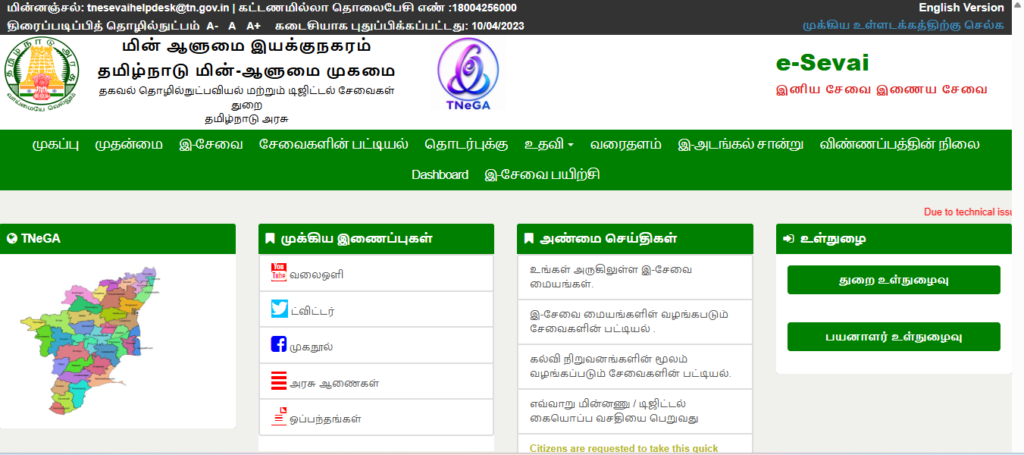
Eligible families can enquire about the scheme and its application procedure through a nearby Tamil Nadu e-Sevai centre or the District Social Welfare and Women Empowerment Office. The Tamil Nadu e-Sevai service list includes separate services for Chief Minister’s Girl Child Protection Scheme-I and Scheme-II.
The general process is to confirm eligibility, collect the relevant application form, submit the required details and supporting documents, and complete any verification requested by the authorities. Applicants should obtain an acknowledgement or application reference number where available and keep it safely for future enquiries.
Parents should apply as early as possible because published guidance states that the application should be submitted before the girl child reaches three years of age. The exact deadline and any applicable exceptions should be verified with the responsible department. Approval is subject to document verification and the official rules governing the scheme.
Importance of the Scheme for Girls’ Education
Education is one of the central priorities of the Chief Minister’s Girl Child Protection Scheme. Financial difficulties can prevent children from continuing their studies, particularly when families have limited resources. By creating a deposit in the girl’s name, the scheme aims to provide financial support at a stage when she may be preparing for higher secondary education, college, or vocational training.
The scheme also sends a wider social message that girls deserve the same educational opportunities and future aspirations as boys. Parents are encouraged to invest in their daughters’ development and help them become independent adults. Although the deposit alone cannot cover every educational expense, it can contribute towards important costs and provide a measure of financial security.
Role of the Tamil Nadu Government
The Tamil Nadu Government implements the scheme through its social welfare administration, with district-level offices helping eligible families understand the requirements and access benefits. The programme forms part of broader efforts to improve the welfare of children, promote gender equality, and reduce discriminatory practices against girls.
Parents and guardians can approach their district Social Welfare and Women Empowerment Office for information about eligibility, application status, deposit records, and maturity claims. Official announcements should be checked for changes in procedures or requirements. Applicants should rely on authorised government channels rather than unofficial agents promising guaranteed approval.
How to Claim the Maturity Amount
When the beneficiary reaches 18 years of age, the family should contact the relevant district office to understand the maturity-claim procedure. The department may require the original deposit receipt or bond, the girl’s educational records, photographs, bank account details, and other supporting documents. The exact list should be confirmed before submitting the claim.
Families should not assume that the amount will be transferred automatically upon the girl’s eighteenth birthday. Completing the required formalities and meeting the scheme’s conditions may be necessary. If the maturity amount has not been claimed, beneficiaries should enquire with their district office about the available procedure and any outstanding documentation.
Conclusion
The Chief Minister’s Girl Child Protection Scheme is an important Tamil Nadu welfare initiative that combines financial assistance with the goals of education, gender equality, and long-term security for eligible girl children. Through Scheme-I and Scheme-II, qualifying families can receive fixed deposits of ₹50,000 for one girl child or ₹25,000 for each of two girl children, subject to the applicable rules.
For parents, understanding the eligibility criteria, preparing the necessary documents, applying within the prescribed period, and keeping deposit records safe are important steps. Since certain eligibility details and administrative requirements may change, families should confirm the latest rules through an authorised e-Sevai centre or the District Social Welfare and Women Empowerment Office before applying.